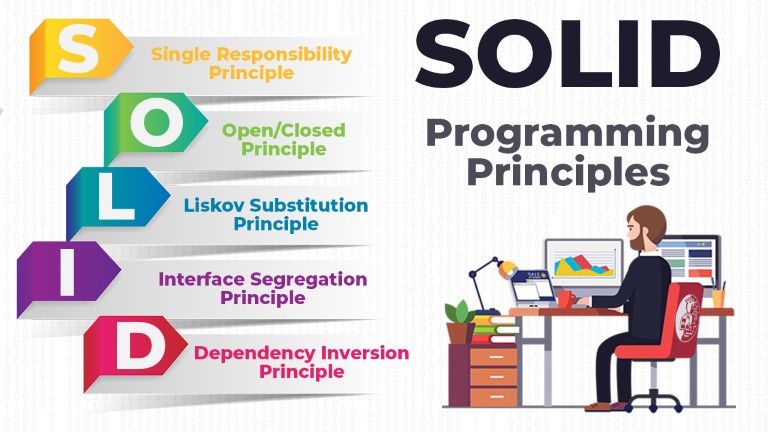
The SOLID principles are five design rules that help developers write clean, maintainable, and scalable software.
1. Single Responsibility Principle (SRP)
Why SRP is important?
- Makes code easier to read and understand.
- Reduces the risk of breaking other parts when making changes.
- Simplifies future maintenance.
2. Open/Closed Principle (OCP)
How to apply OCP?
- Use interfaces or abstract classes to define extensions.
- Follow inheritance and polymorphism to add functionality.
3. Liskov Substitution Principle (LSP)
How to follow LSP?
- Avoid overriding methods in a way that changes their original behavior.
- Use consistent interfaces for parent and child classes.
4. Interface Segregation Principle (ISP)
Why ISP is useful?
- Reduces unwanted dependencies.
- Makes code easier to understand and test.
5. Dependency Inversion Principle (DIP)
How to use DIP?
- Use dependency injection to pass required objects.
- Depend on interfaces, not specific implementations.
Why SOLID Principles Matter?
- Scalability: You can easily add new features without affecting existing code.
- Maintainability: Debugging and updates become simpler.
- Team Collaboration: Clear class responsibilities make it easier for teams to work together.
 Computer Wale Sir